
Move-In/Move-Out Inspection Checklist
Complete room-by-room inspection form with photo documentation guide and security deposit deduction worksheet.
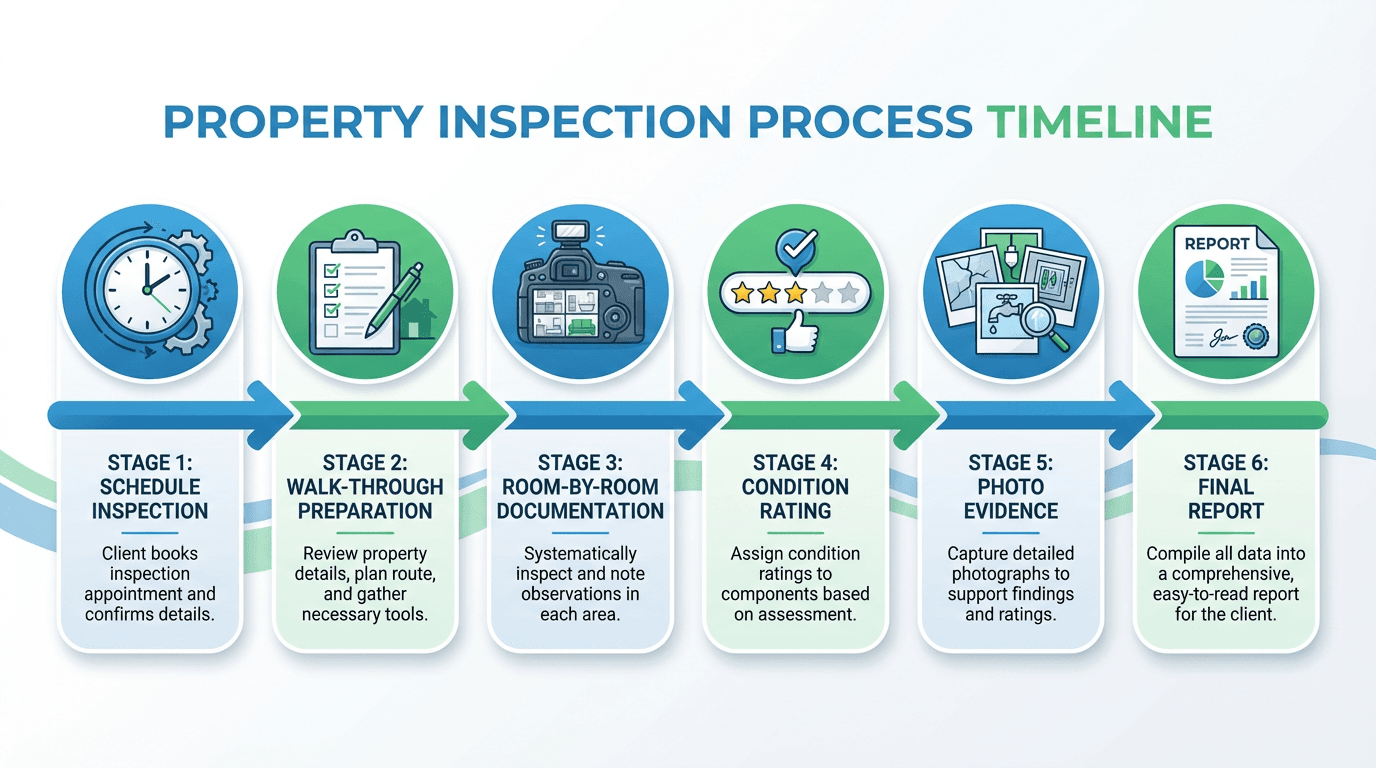
Why property inspections matter
A move-in inspection records the condition of the unit on day one; a move-out inspection compares it at the end. If you later deduct from a security deposit, the two records together are your evidence that the damage happened during the tenancy and goes beyond normal wear and tear. Without a dated move-in record, most deduction disputes come down to your word against the tenant’s.
Below you’ll find a printable room-by-room checklist, then a full guide to timing, photo and video documentation, the difference between wear and tear and damage, how deductions are calculated (including a worked example that prorates the remaining life of a carpet), and the state deadlines that apply once a tenant moves out.
Note: this is general information, not legal advice. Security deposit rules are set by state law and sometimes by city ordinance. Check the statute for your state and consult a licensed attorney if a dispute is likely.
Room-by-Room Inspection Guide
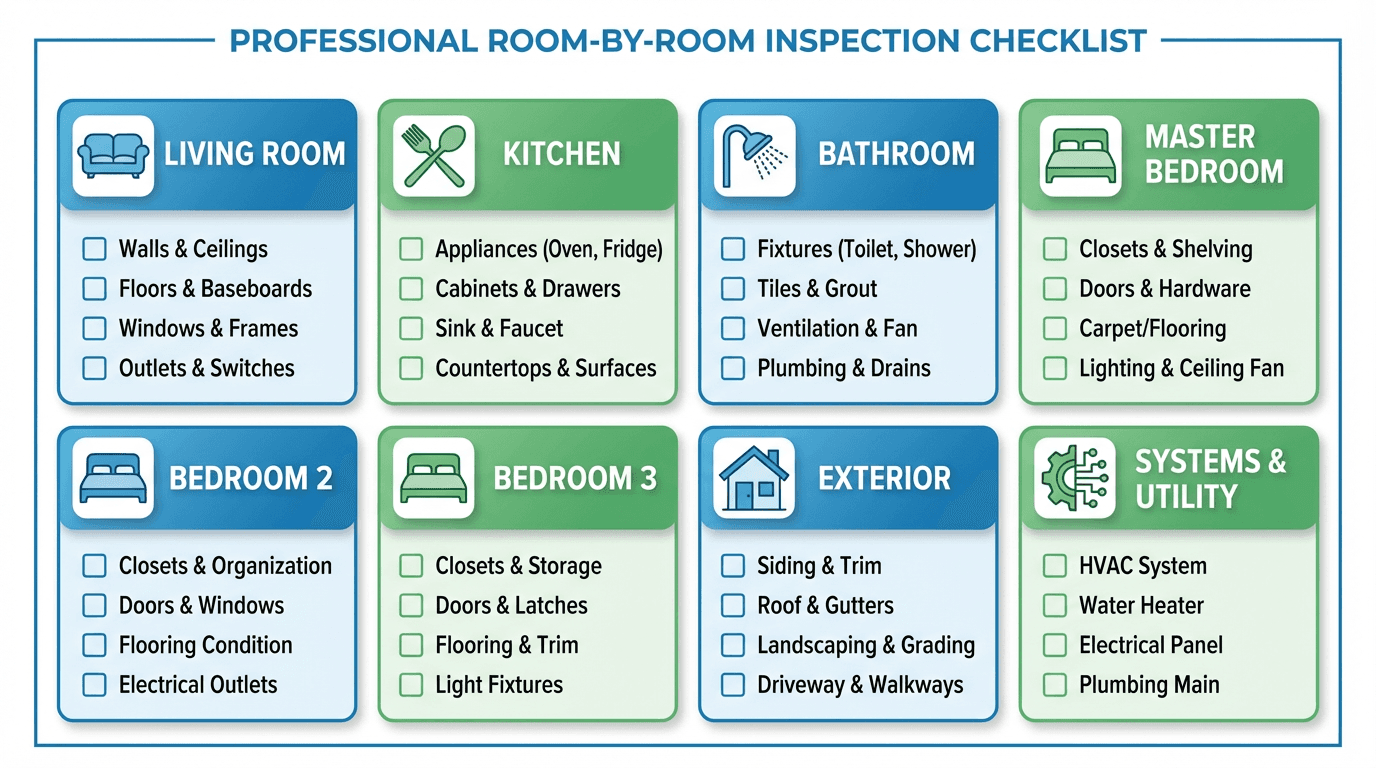
Property Inspection Checklist
Use this checklist for both move-in and move-out inspections. Rate each item's condition and take photos for documentation.
Condition Rating Guide
Property Information
🛋️ Living Room
| Item | Move-In | Move-Out | Photo |
|---|---|---|---|
| Walls (paint, damage, holes) | |||
| Ceiling (cracks, stains, texture) | |||
| Flooring (carpet, hardwood, tile) | |||
| Baseboards & trim | |||
| Windows (glass, screens, tracks) | |||
| Window coverings (blinds, curtains) | |||
| Doors (operation, locks, damage) | |||
| Light fixtures & switches | |||
| Electrical outlets & covers | |||
| Smoke detector (functional) |
🍳 Kitchen
| Item | Move-In | Move-Out | Photo |
|---|---|---|---|
| Walls & ceiling | |||
| Flooring | |||
| Cabinets (doors, shelves, hardware) | |||
| Countertops | |||
| Sink & faucet | |||
| Refrigerator (clean, working) | |||
| Stove/Range (burners, oven, clean) | |||
| Dishwasher (working, clean) | |||
| Microwave (if included) | |||
| Garbage disposal (working) |
🚿 Bathroom(s)
| Item | Move-In | Move-Out | Photo |
|---|---|---|---|
| Walls, ceiling, & paint | |||
| Flooring / tile | |||
| Grout & caulking | |||
| Vanity & countertop | |||
| Sink & faucet | |||
| Toilet (clean, working, no leaks) | |||
| Shower/tub (clean, working, drain) | |||
| Shower door/curtain rod | |||
| Mirror & light fixtures | |||
| Exhaust fan (working) |
🛏️ Bedroom(s)
Complete for each bedroom separately
| Item | Move-In | Move-Out | Photo |
|---|---|---|---|
| Walls & ceiling | |||
| Flooring / carpet | |||
| Closet (door, shelving, rod) | |||
| Windows & coverings | |||
| Door & hardware | |||
| Light fixtures & outlets |
📦 Additional Areas
| Item | Move-In | Move-Out | Photo |
|---|---|---|---|
| Hallways | |||
| Stairways | |||
| Laundry area (if included) | |||
| Washer/Dryer (if included) | |||
| Storage areas / closets | |||
| Garage / carport | |||
| Patio / balcony |
🏡 Exterior
| Item | Move-In | Move-Out | Photo |
|---|---|---|---|
| Exterior walls / siding | |||
| Roof (visible condition) | |||
| Gutters & downspouts | |||
| Entry doors & locks | |||
| Mailbox | |||
| Landscaping / lawn | |||
| Driveway / walkways | |||
| Fencing / gates |
❄️🔥 HVAC & Systems
| Item | Move-In | Move-Out | Photo |
|---|---|---|---|
| Heating system (working) | |||
| Air conditioning (working) | |||
| Thermostat (functional) | |||
| Water heater (working, no leaks) | |||
| Plumbing (no leaks visible) | |||
| Smoke detectors (all functional) | |||
| Carbon monoxide detector |
🔑 Keys & Access Items
✍️ Acknowledgment & Signatures
Both parties acknowledge that this inspection accurately reflects the condition of the property on the date indicated above.
Photo Documentation Best Practices
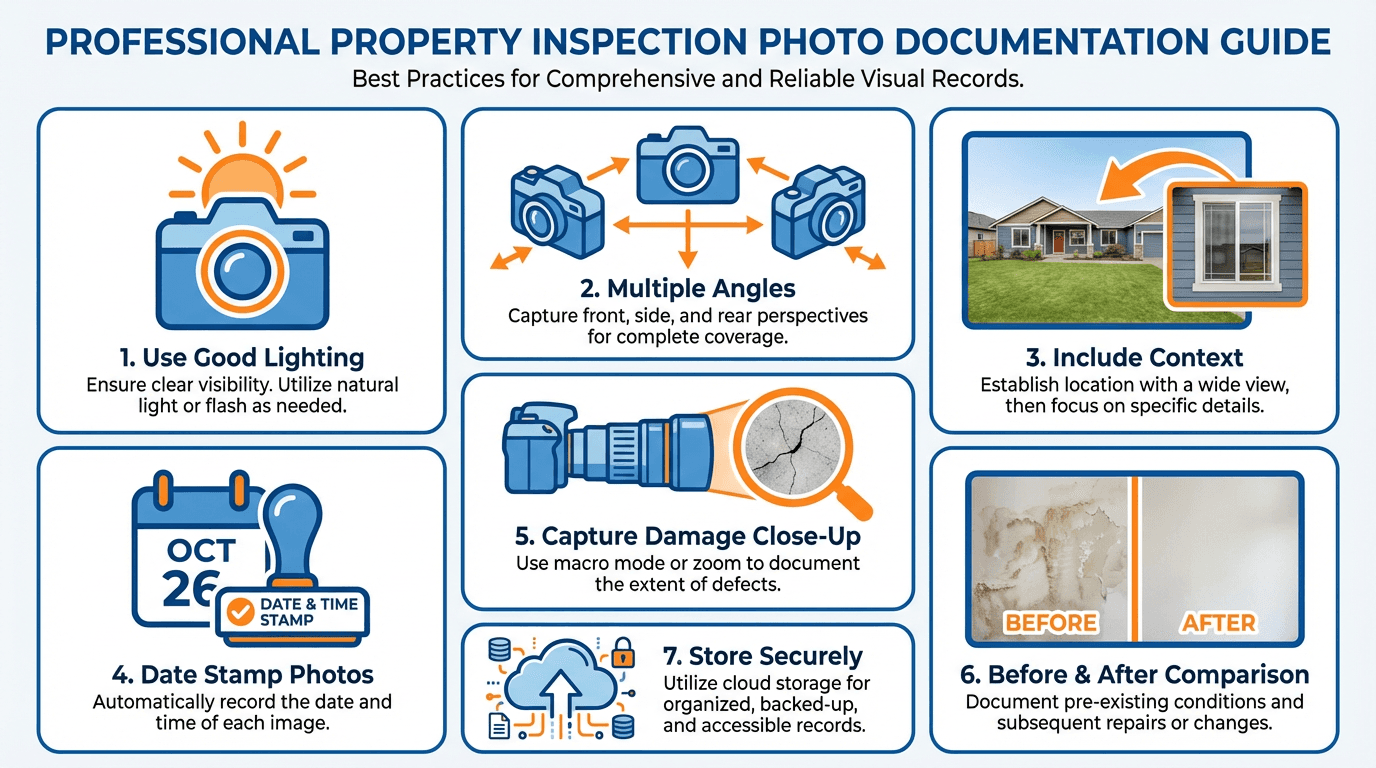
📸 Essential Photography Tips
- Take wide shots of each room to show overall condition
- Capture close-ups of any damage or wear
- Use natural lighting when possible for accurate colors
- Include reference points (doors, windows) for scale
- Date-stamp photos using camera settings or apps
- Take multiple angles of problem areas
- Store organized by room and inspection date
- Back up to cloud storage immediately after inspection
Preventing Security Deposit Disputes
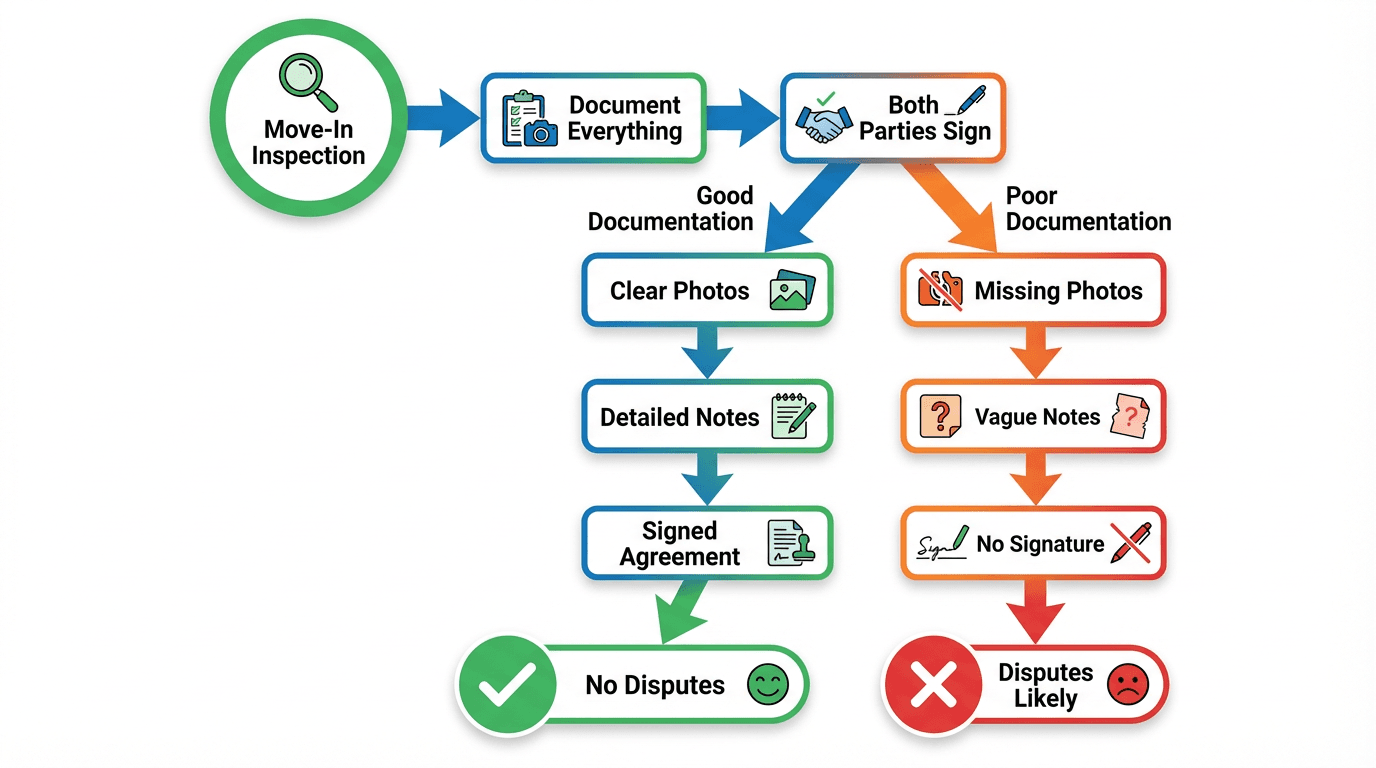
✅ Do's
- ✓ Complete inspection with tenant present
- ✓ Take photos of everything, even if perfect
- ✓ Get tenant signature on inspection report
- ✓ Provide copy to tenant immediately
- ✓ Use consistent rating system
- ✓ Document pre-existing damage thoroughly
- ✓ Store all documentation for entire tenancy
❌ Don'ts
- ✗ Skip inspection to save time
- ✗ Use vague descriptions like "worn"
- ✗ Forget to date and sign documents
- ✗ Start repairs before taking move-out photos
- ✗ Lose or delete inspection photos
- ✗ Conduct inspection in poor lighting
- ✗ Rush through the process
💰 Security Deposit Deduction Worksheet
Use this worksheet to calculate and document security deposit deductions. All deductions must be for damage beyond normal wear and tear.
| Item / Damage Description | Cost | Photo Evidence |
|---|---|---|
| $ | ||
| $ | ||
| $ | ||
| $ | ||
| $ |
🏆 Inspection Best Practices
Before Inspection
- • Give the written notice your state requires
- • Bring printed inspection forms
- • Charge camera/phone fully
- • Bring flashlight for dark areas
- • Have clipboard and pens
During Inspection
- • Walk through systematically
- • Tenant should be present
- • Test all appliances and fixtures
- • Note everything, even if perfect
- • Photograph every room, even if perfect
After Inspection
- • Get tenant signature immediately
- • Provide copy to tenant
- • Back up photos to cloud
- • File with lease documents
- • Set reminder for move-out inspection
When to inspect: timing for move-in, mid-tenancy and move-out
Move-in inspection
Do the inspection after the unit has been cleaned and repaired for the new tenant but before they move any belongings in. Furniture hides carpet stains and wall damage, and once boxes arrive it becomes impossible to say who caused what. The best time is the day keys are handed over, with the tenant present. If the tenant cannot attend, complete it yourself, give them a copy, and invite them to add written notes within a short set period (for example, seven days) so their own observations become part of the record.
Some states build this into the law. New York, for instance, requires the landlord to offer the tenant the chance to inspect the unit together after lease signing and before occupancy; if the tenant asks, both sign a written agreement noting existing defects, and the landlord cannot later deduct for anything listed in it (N.Y. Gen. Oblig. Law § 7-108(1-a)(c)).
Mid-tenancy inspections
An annual walkthrough (often combined with smoke-alarm tests and filter changes) lets you spot leaks and maintenance issues early and gives you a dated record midway through a long tenancy. Give the advance written notice your state and lease require for entry. In California, for example, 24 hours’ written notice is presumed reasonable and entry must be during normal business hours except in an emergency or with the tenant’s consent (Cal. Civ. Code § 1954). Other states differ, and some set no specific number, so check your state legal guide.
Pre-move-out and final inspections
A pre-move-out walkthrough a week or two before the tenant leaves gives them a chance to fix problems themselves, which is usually cheaper for everyone and avoids disputes. In some states it is mandatory on request. California requires the landlord to tell the tenant in writing of the right to request an initial inspection no earlier than two weeks before the tenancy ends, with 48 hours’ written notice, and to leave an itemized list of proposed deductions so the tenant can remedy them (Cal. Civ. Code § 1950.5(f)). New York has a similar right to a pre-move-out inspection held between two weeks and one week before the end of the tenancy (§ 7-108(1-a)(d)).
The final inspection happens after the tenant has returned the keys and removed everything, and before you start any cleaning or repairs. Doing repairs first destroys the evidence you need.
Photo and video documentation that holds up
Photos are the backbone of the record. A checklist entry that says “carpet: good” is helpful; a dated photo of the same carpet is far stronger. California now makes photos a legal requirement: for tenancies beginning on or after July 1, 2025, landlords must photograph the unit immediately before or at the start of the tenancy, and since April 1, 2025 must photograph it after the tenant leaves (before repairs) and again after repairs, then provide those photos with any itemized deductions (Cal. Civ. Code § 1950.5(g) and (h)(2)(D)). Even where the law does not require it, the same practice is sensible everywhere.
- Shoot in a consistent order. Start at the front door and move clockwise through each room, so move-in and move-out sets match.
- Wide shot first, then details. One photo from each corner of every room, then close-ups of anything worth noting, with a coin or tape measure for scale.
- Open everything. Inside the oven, fridge, dishwasher, cabinets, closets and under sinks. Run taps and show the water heater label.
- Record a walkthrough video with narration (“Unit 2, hallway, small chip in door frame at hinge height”). Video makes it hard to argue that photos were selective.
- Keep original files. The embedded metadata (date, time, device) is part of the evidence. Don’t rely only on screenshots or compressed copies sent through messaging apps.
- Share and store. Send the tenant a link to the full set with the signed checklist, and keep a backup at least until any deposit claim is resolved and the time to sue has passed.
- Capture meter readings and keys. Photograph utility meters and the number of keys, fobs and remotes handed over.
The room-by-room checklist, explained
The printable checklist above lists the items to rate in each room. A few areas generate most of the disputes, so give them extra attention:
- Floors. Note carpet stains, burns, pet damage, seams and the carpet’s age. For hard floors, record scratches, water damage and loose tiles.
- Walls and ceilings. Nail holes, anchors, scuffs, cracks, water stains and the date the walls were last painted.
- Kitchen. Appliance condition and cleanliness inside and out, countertop burns or chips, cabinet doors and hinges, sink sprayer, disposal.
- Bathrooms. Caulk and grout condition, mold, toilet operation, exhaust fan, drains, mirror and towel bars.
- Windows and doors. Screens, cracked glass, blinds, locks, door stops and weatherstripping.
- Safety items. Smoke and carbon monoxide alarms tested and dated, fire extinguisher if provided.
- Outside and storage. Garage, yard, decks, parking space and any storage units included in the lease.
Use specific descriptions rather than single-word ratings. “Fair” means different things to different people; “two 1-inch stains near closet, carpet installed March 2021” does not. Record install or last-replacement dates for carpet, paint, appliances and blinds wherever you know them. You will need those dates to calculate deductions fairly.
Normal wear and tear vs. damage
Every state bars landlords from charging tenants for ordinary wear and tear. Texas defines it as deterioration that results from the intended use of a dwelling, but not deterioration that results from negligence, carelessness, accident or abuse by the tenant, household members or guests (Tex. Prop. Code § 92.001; § 92.104(b) bars deductions for it). California goes further and bars claims for the cumulative effects of wear and tear across one or more tenancies (§ 1950.5(e)). A useful test: would this have happened with careful, ordinary living over the same period?
| Normal wear and tear (not deductible) | Damage (potentially deductible) |
|---|---|
| Carpet worn flat in walkways, light fading from sun | Pet urine stains, burns, rips, large permanent stains |
| A few small nail holes from hanging pictures | Large holes, many anchor holes, a doorknob hole through drywall |
| Paint slightly faded or lightly scuffed after several years | Unapproved paint colors, crayon or marker, smoke staining |
| Loose door handles, worn cabinet hinges | Doors off hinges, broken cabinet doors |
| Minor scratches on hardwood from normal furniture use | Deep gouges, water damage from an overflowing tub left running |
| Dulled grout, aging caulk | Mold from a tenant who never ran the exhaust fan despite written reminders |
| Faded or slightly bent blinds | Missing or chewed blinds, broken window screens |
| An appliance that fails from age | A cracked fridge shelf or a broken oven door |
Cleaning is a separate category. Most states let you charge to return the unit to the level of cleanliness it had at move-in, not to a higher standard. California, for instance, limits cleaning deductions to that standard and restricts charges for professional carpet cleaning to cases where it is reasonably necessary (§ 1950.5(b)(3) and (e)(2)(C)). Your move-in photos are what prove the starting level.
How inspections support security deposit deductions
When you deduct from a deposit, the burden is usually on you to show that the charge is lawful and reasonable. A signed move-in checklist, matching move-out checklist, photos, and invoices or receipts for the actual work make that case. Courts tend to be skeptical of round-number estimates without paperwork.
Every state sets its own deadline and procedure for returning the deposit and sending an itemized list of deductions. Here are four, verified against the statutes:
- California: itemized statement and refund no later than 21 calendar days after the tenant vacates, with copies of invoices or receipts and the required photos (deductions for repairs and cleaning of $125 or less are exempt from the receipts requirement); bad-faith retention can cost up to twice the deposit in statutory damages (Cal. Civ. Code § 1950.5(h), (m)).
- Texas: refund on or before the 30th day after the tenant surrenders the premises, with a written description and itemized list of deductions; the landlord need not refund until the tenant provides a written forwarding address (Tex. Prop. Code §§ 92.103, 92.104, 92.107). Bad-faith retention can cost $100 plus three times the amount wrongfully withheld, plus attorney’s fees (§ 92.109).
- Florida: with no claim, return the deposit within 15 days; to make a claim, send written notice by certified mail (or email where permitted) within 30 days in the statutory form, after which the tenant has 15 days to object (Fla. Stat. § 83.49(3)). Missing the 30-day notice forfeits the right to claim against the deposit.
- New York: itemized statement and the balance within 14 days after the tenant vacates; missing the deadline forfeits the right to keep any portion of the deposit (N.Y. Gen. Oblig. Law § 7-108(1-a)(e)).
For other states, and for Illinois, see the state legal guides (including California, Texas, Florida, New York and Illinois) and read your state’s current statute. Some cities, such as Chicago, add their own rules. The security deposit calculator can help you work through the numbers.
Worked example: prorating a deduction by remaining useful life
Illustrative example with hypothetical numbers. Charging a tenant the full cost of brand-new carpet when the old carpet was already six years old would leave you better off than before the damage. Deductions are generally limited to what is reasonably necessary to restore the unit to its move-in condition, less wear and tear (see, for example, Cal. Civ. Code § 1950.5(e)), so prorating by remaining useful life is a common and defensible approach: the tenant pays only for the life they cut short. The useful-life figures below are assumptions for this example; there is no single national table, so use reasonable figures for the quality of item you installed and be ready to explain them.
A tenant moves out of a two-bedroom unit after a two-year lease. The deposit is $2,000. Comparing move-in and move-out records, the landlord finds:
- Bedroom carpet ruined by pet urine (no pet was allowed on the lease; stains not present in move-in photos). Replacement for that room costs $1,200. The carpet was installed 6 years ago and the landlord assumes a 10-year life. Remaining life: 10 − 6 = 4 years, so 4 ÷ 10 = 40%. Chargeable: $1,200 × 40% = $480.
- Hole through hallway drywall from a door swung without a stop. This is a repair, not a replacement, so there is nothing to depreciate. Invoice: $150.
- Living room painted dark red without permission, needing primer and two coats to restore. Repaint cost $400. The walls were last painted 3 years ago and the landlord assumes a 5-year paint life. Remaining life: 2 ÷ 5 = 40%. Chargeable: $400 × 40% = $160.
- Oven and refrigerator left dirty, compared with clean move-in photos. Cleaning invoice: $120.
- Faded blinds, light scuffs and a few small nail holes. Normal wear and tear: $0.
Total deductions: $480 + $150 + $160 + $120 = $910
Refund to tenant: $2,000 − $910 = $1,090
Without proration the landlord might have charged $1,200 + $150 + $400 + $120 = $1,870, leaving only $130 for the tenant. The extra $960 is exactly the kind of charge that loses in small claims court and, in some states, can trigger penalties for bad-faith retention.
The itemized statement should list each item, the cost, how you calculated it (including the age and assumed life), and attach the invoices and photos. If you did the work yourself, record the time spent and a reasonable hourly rate; California requires exactly that (§ 1950.5(h)(2)(A)). Send it by the method and deadline your state requires.
Tenant walkthrough etiquette
The walkthrough is as much a conversation as an inspection. Handled well, it settles most issues before they become disputes.
- Schedule it in writing with the notice your state requires, and offer a couple of times, including one outside working hours if you can.
- Bring the move-in record. Walk the same route with the original checklist and photos on hand, so differences are obvious.
- Describe, don’t accuse. “There’s a stain here that isn’t in the move-in photo” lands better than “you ruined the carpet.”
- Don’t promise numbers on the spot. Say you will send an itemized statement with costs once you have quotes or invoices.
- Let the tenant add comments to the checklist before both of you sign. A signature can mean “I was present,” not necessarily “I agree,” and the form should say so.
- Treat everyone the same. Use the same checklist, standards and tone with every tenant. Consistent process is fair and also protects you under fair housing law; see the fair housing cheat sheet.
- Collect the forwarding address in writing at move-out. Several states tie the refund to it.
Common inspection mistakes
- Skipping the move-in inspection, or doing it after the tenant has moved furniture in.
- Writing vague ratings with no dates, ages or measurements.
- Starting repairs or cleaning before photographing the unit at move-out.
- Charging full replacement cost for old carpet, paint or blinds instead of prorating.
- Deducting for ordinary wear and tear, or for damage that was on the move-in checklist.
- Missing the state deadline for the itemized statement, which in several states forfeits the right to deduct anything.
- Not keeping receipts, invoices and photos together for each deduction.
Inspection records also matter when you sell a rental with tenants in place: the buyer will want to know the deposit balance and the unit’s documented condition. If you are weighing that decision, the keep-or-sell rental property calculator compares the after-tax outcomes, and the move-in/move-out inspection guide on the blog covers the process in more detail.
Frequently asked questions
When should a move-in inspection be done?
After the unit has been cleaned and repaired but before the tenant moves in any belongings, ideally on the day keys are handed over with the tenant present. Furniture and boxes hide damage, so an inspection done after move-in is much weaker evidence. If the tenant cannot attend, give them a copy and a short window to add their own written notes.
What is the difference between normal wear and tear and damage?
Normal wear and tear is deterioration from ordinary, intended use over time, such as carpet worn in walkways, faded paint or a few small nail holes. Damage results from negligence, carelessness, accident or abuse, such as pet stains, burns, large holes or unapproved paint. Texas Property Code section 92.001 uses this distinction, and every state bars deducting for ordinary wear and tear.
Can I charge a tenant the full cost of replacing a damaged carpet?
Usually not if the carpet was already partway through its life. Deductions are generally limited to what is reasonably necessary to restore the unit, so a common approach is to prorate by remaining useful life. For example, if a carpet with an assumed 10-year life is 6 years old, the tenant would pay 40 percent of the replacement cost for the damaged area.
How long do I have to return a security deposit after move-out?
It depends on the state. California allows 21 calendar days (Civil Code 1950.5), Texas 30 days after surrender (Property Code 92.103), and New York 14 days (General Obligations Law 7-108). In Florida you have 15 days to return the deposit if you make no claim, or 30 days to send a certified notice of intent to claim (Statutes 83.49). Check your state statute; missing the deadline can forfeit your right to deduct.
Do I have to take photos at move-in and move-out?
In California, yes: for tenancies starting on or after July 1, 2025, landlords must photograph the unit at or just before move-in, and must photograph it after move-out and again after repairs, then provide the photos with any itemized deductions. Elsewhere photos may not be legally required, but they are the strongest evidence you can have in a deposit dispute.
Does the tenant have to sign the inspection checklist?
A tenant signature is not always legally required, but it makes the record far more persuasive. Let the tenant add comments before signing, and note on the form that a signature confirms presence at the inspection. If a tenant refuses to sign, note the refusal, date it, and send them a copy of the checklist and photos.
Should I offer a pre-move-out inspection?
Yes, and in some states it is required on request. California and New York both require landlords to notify tenants of the right to an inspection before move-out and to list proposed deductions so the tenant can fix them. Even where it is optional, it gives the tenant a chance to clean or repair and usually reduces disputes.